

From the corner grocery store to massive automated fulfillment centers handling millions of packages daily, barcodes remain the undisputed backbone of global trade. Despite the rapid rise of digital payment apps and two-dimensional QR codes, linear (1D) barcodes continue to dominate retail checkouts, medical supply chains, and warehouse inventory systems worldwide.
However, for growing small business owners, artisans, and manufacturers stepping into retail distribution, barcoding often seems confusing. What is the difference between a UPC and an EAN? When should you use Code 128 instead of Code 39? Do you need to buy official numbers from GS1, or can you generate your own internal SKU barcodes? In this straightforward guide, we will demystify global barcode standards and provide practical advice for selecting, generating, and printing barcodes for your business.
The Evolution of Barcoding: Why Linear Codes Still Rule
Linear barcodes were first patented in 1952 by Norman Joseph Woodland and Bernard Silver, inspired by Morse code extended into thick and thin parallel lines. In 1974, a pack of Wrigley’s chewing gum became the first product ever scanned at a supermarket checkout in Troy, Ohio, utilizing the newly introduced Universal Product Code (UPC).
Decades later, 1D barcodes remain ubiquitous because handheld laser and optical imager scanners can read them with astonishing velocity—frequently under 50 milliseconds per scan. Checkout cashiers do not need to carefully align a camera viewfinder; they simply swipe packaging across an omnidirectional scanner bed.

Core Retail Standards: UPC-A vs. EAN-13
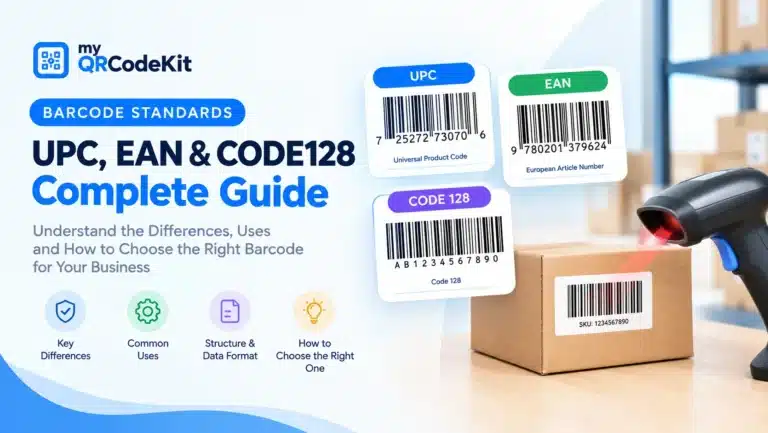
If you are selling consumer goods in brick-and-mortar stores or major online marketplaces like Amazon, you will primarily encounter two closely related global standards: UPC-A and EAN-13. Both are governed by GS1, the nonprofit international standards organization.
1. UPC-A (Universal Product Code)
The UPC-A standard is the legacy barcode format of North America (the United States and Canada). It encodes exactly 12 numerical digits:
- Digit 1: Number system character indicating product category (e.g., standard items, pharmacy, coupons).
- Digits 2–6: GS1 Company Prefix assigned specifically to your brand.
- Digits 7–11: Unique Item Reference number assigned by you to identify the specific product variation (size, color, flavor).
- Digit 12: Mathematical check digit calculated using a weighted modulo-10 formula to detect scanning misreads.
2. EAN-13 (International Article Number)
Originally called the European Article Number, EAN-13 is the superset of UPC-A and serves as the international retail standard across Europe, Asia, Latin America, Australia, and Africa. It encodes 13 numerical digits:
- Digits 1–3: GS1 Country Code prefix indicating the national GS1 member organization where the company registered (e.g., 000–019 for US, 500–509 for UK, 400–440 for Germany, 890 for India).
- Digits 4–7: Manufacturer / Company identifier.
- Digits 8–12: Individual product reference SKU.
- Digit 13: Modulo-10 checksum digit.
Crucial Compatibility Fact: A 12-digit North American UPC-A code is mathematically identical to a 13-digit EAN code with a leading zero (0). Virtually every modern barcode scanner and point-of-sale system in the world can process both UPC-A and EAN-13 interchangeably.
Industrial & Logistics Powerhouse: Code 128
While retail checkouts rely strictly on fixed-length numerical barcodes, manufacturing facilities, warehouses, hospitals, and courier delivery services require substantially greater flexibility. For these applications, Code 128 is the gold standard.

What Makes Code 128 Special?
- Full 128 ASCII Character Set: Unlike UPC or EAN, Code 128 can encode numbers, uppercase letters, lowercase letters, punctuation, and system control codes (such as TAB or ENTER keys on keyboard wedge scanners).
- High Data Density: It uses three interchangeable character sets (A, B, and C). Character Set C encodes pairs of numbers into single bar patterns, achieving remarkable compression for long serial numbers.
- Variable Length: You can encode short 4-digit bin numbers or lengthy 30-character shipping container tracking numbers with equal precision.
- Dual Internal Check Digits: Code 128 includes rigorous self-checking algorithms, resulting in an exceptionally low error misread rate (less than one in several million scans).
Do You Need Official GS1 Numbers or Free Internal Barcodes?
One of the most frequent points of confusion for startups is whether they must pay to register official barcodes. The answer depends entirely on where your items are being sold:
When You MUST Purchase from GS1:
If you plan to sell your physical merchandise through national or regional retail store chains (Walmart, Target, Tesco, Carrefour) or major e-commerce platforms (Amazon, eBay, Google Shopping), you must obtain official GS1-registered barcodes. Retailers will reject duplicate or unofficial barcodes, and Amazon strictly checks product prefixes against the global GS1 GEPIR database.
When You Can Generate FREE Barcodes:
If you are managing operations within your own ecosystem, you do NOT need to spend hundreds of dollars on GS1 registrations. You can freely generate unlimited barcodes for:
- Internal warehouse inventory, SKU management, and bin tracking.
- Local Point-of-Sale (POS) systems in your own boutique, cafe, or private store.
- Asset management (tagging laptops, office furniture, or industrial tools).
- Event badges, cloakroom tickets, and customer loyalty cards.
- Manufacturing batch numbers and quality control lot tracking.
Our free Barcode Generator and Code 128 Generator allow you to create, format, and download verified vector SVG barcodes instantly with zero licensing restrictions.
Best Practices for Barcode Printing & Readability
A barcode that fails to scan at checkout or in the warehouse causes operational bottlenecks and costly manual data entry. Follow these essential production rules:
- Respect the Quiet Zones: Just like QR codes, linear barcodes require clear blank margins (quiet zones) to the immediate left and right of the first and last bars. Keep at least 10 times the width of the narrowest bar completely blank on both sides.
- Beware of Color Choices: Barcode scanners use red light lasers or red LED illumination. Because red light reflects off red surfaces, never print red bars, and never print bars on a red, orange, or pink background! The ideal combination is dark black or deep navy bars on a pure white or cream background.
- Preserve Aspect Ratio & Bar Thickness: When resizing barcodes in graphics editing software, never stretch or compress the horizontal width independently of the vertical height. Distorting the proportional widths between thick and thin bars destroys scannability.
- Orient Bars with the Print Direction: If printing on flexographic label presses or thermal ribbon printers, align the vertical bars parallel to the direction of web travel. Printing across the printhead can cause thermal bleeding that widens bars and reduces scan accuracy.
Conclusion
Understanding barcode standards empowers you to make smart, cost-effective decisions as your business scales. Use EAN-13 or UPC-A for official retail distribution, leverage Code 128 for high-density warehouse logistics, and always download crisp vector formats to guarantee flawless scanning on the production floor.
Leave a Reply